Reformatting strategies
Two main strategies are available:
1. Base-wise Statistics
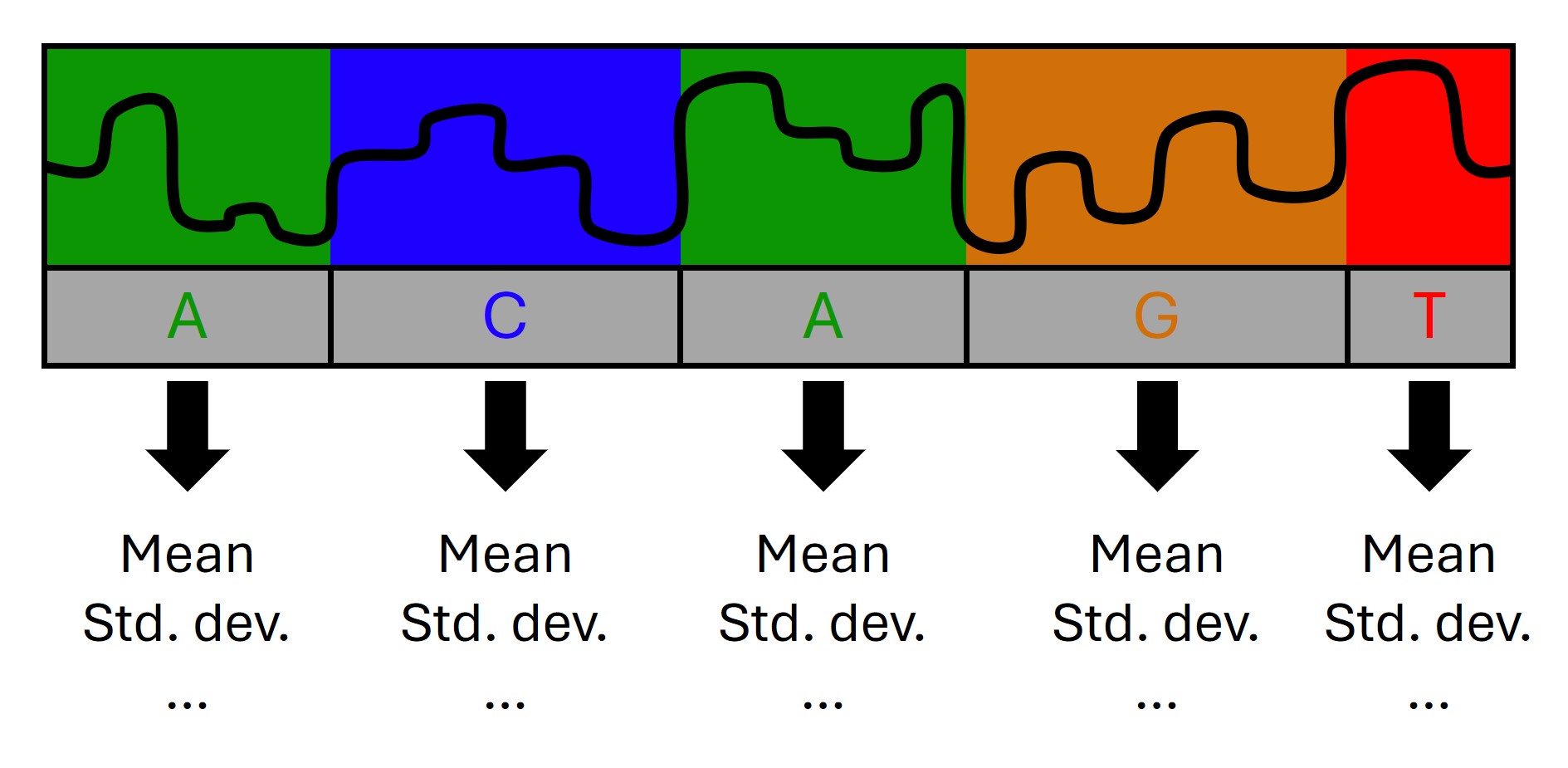
Each signal segment aligned to a base of interest is summarized into statistics that represent its characteristics.
| Statistic | Description |
|---|---|
mean |
Mean signal intensity |
median |
Median signal intensity |
std |
Standard deviation of signal intensity |
dwell |
Dwell time (number of signal samples assigned to the base) |
signal-to-noise |
Signal-to-noise ratio (mean / std) |
This is the default strategy, but can be enabled explicitly with --strategy stats. By default, mean, std, and dwell are calculated.
You can specify a custom subset via:
--stats <STAT-A> <STAT-B> ...
2. Interpolation into uniform shapes
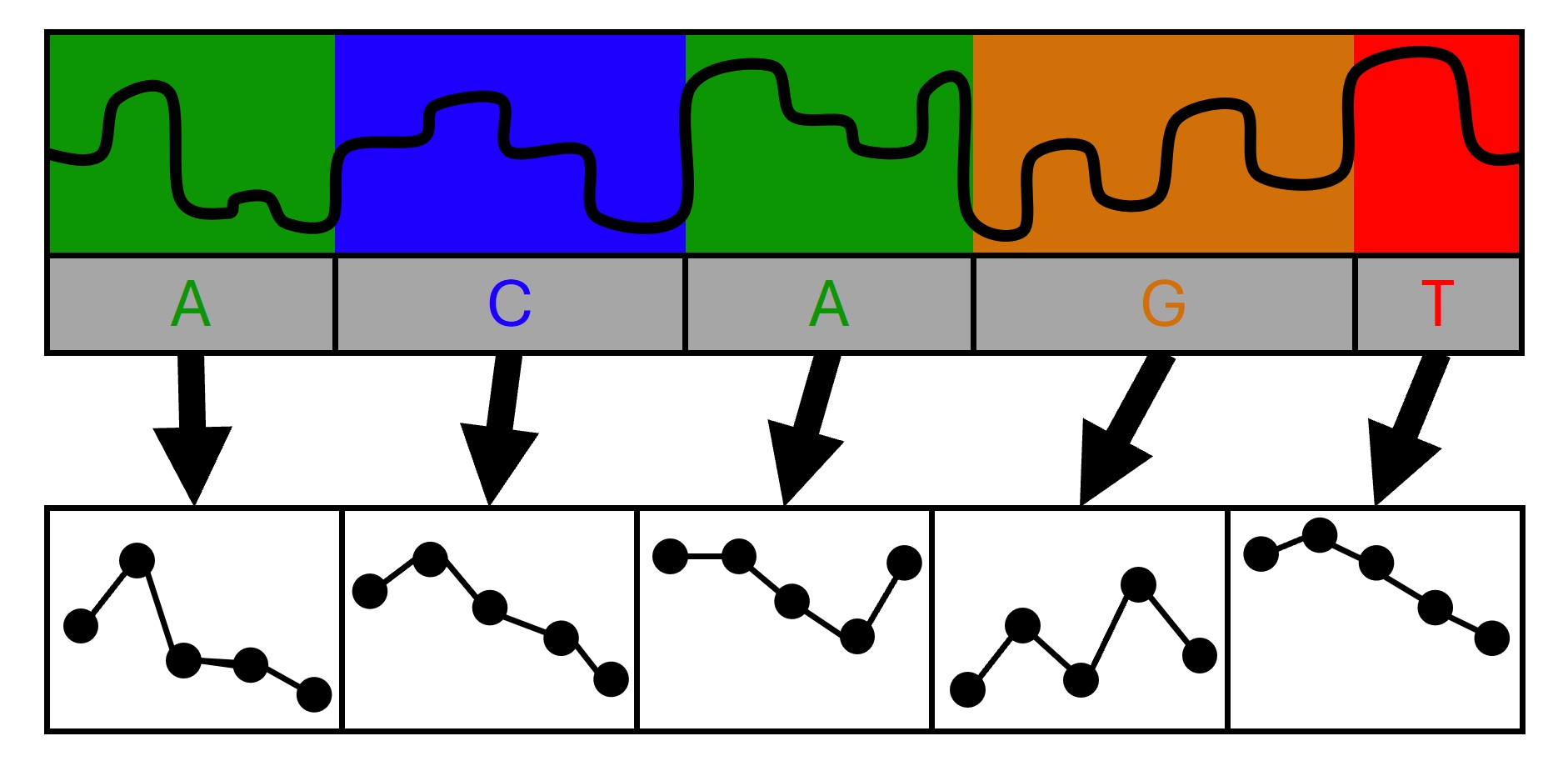
Instead of condensing each segment into statistics, the signal is reshaped into a fixed number of samples per base using linear interpolation. This allows direct comparison or machine-learning-based analysis across bases.
To select this strategy, set --strategy interpolate. The number of samples per base can be tuned using --target-size <NUM-SAMPLES> (default: 30)
Upsampling or downsampling is applied as needed.